
TV Repair vs TV Replacement: What Should You Choose?
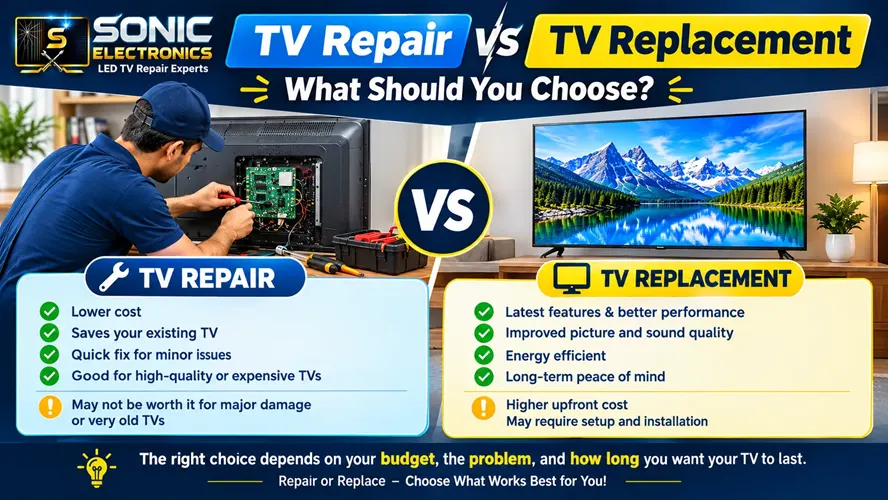
Your TV goes dark in the middle of your favorite show, or a strange line appears across the screen, or it just refuses to turn on. The first thought is usually the same: Is this worth fixing, or is it time to buy a new one?
It’s a frustrating spot to be in. Repair bills can sting, but so can shelling out for a brand-new set. The right answer depends on a few things, and once you know what to look at, the decision gets a lot easier.
Start With the Age of Your TV
Age is the quickest indicator. Most modern TVs last somewhere between 7 and 10 years with normal use. If yours is only 2 to 4 years old, repair almost always makes sense. The technology is still current, parts are easy to find, and the rest of the set has plenty of life left.
If your TV is 8 years old or more, the picture changes. Even if you fix the current problem, other components may start failing soon after. You could end up paying for a second repair within a year, which is a bad way to spend money.
Look at the Cost: The 50% Rule
Here’s a simple rule many technicians use: if the repair costs more than 50% of what a comparable new TV would cost, replace it.
If a new TV like yours costs around 40,000 and the repair quote is 5,000, fix it without hesitation. But if the quote is 25,000 for a set that’s already several years old, you’re better off putting that money toward something new.
Always get a written quote before agreeing to anything, and don’t be shy about getting a second opinion. Prices for the same fault can vary quite a bit between technicians.
What’s Actually Broken Matters
Not all TV Repair in Mayur Vihar problems are equal. Some are cheap and quick to fix, while others are basically a death sentence for the set.
Usually worth repairing:
- Power supply board issues. If the TV won’t turn on or keeps clicking, this is a common and relatively affordable fix.
- Faulty HDMI ports. If your devices aren’t connecting, a port replacement is often inexpensive.
- Sound problems. Speaker or audio board faults are usually simple.
- Remote or sensor issues. Sometimes it’s just a dead sensor or a bad remote, and you don’t need a technician at all. Try fresh batteries first.
- Software glitches. A factory reset or firmware update solves more problems than people expect.
Often better to replace:
- A cracked or damaged screen. On most modern LED and LCD TVs, the panel is the most expensive component, and replacing it can cost nearly as much as a new TV.
- Backlight failure on older sets. If the picture is very dim or you can only see it with a flashlight held close, the backlight strips may be dying. On a newer TV this is fixable, but on an old one it’s rarely worth it.
- Dead pixels or large patches of color distortion. Once panel damage spreads, it doesn’t get better.
- Water damage. Moisture causes hidden corrosion that leads to repeat failures.
Think About Warranty and Parts Availability
Before you do anything else, check whether your TV is still under warranty. Many brands offer one to three years, and some cover the panel for longer. Also look at whether you bought an extended warranty or paid for it with a credit card that offers purchase protection. Plenty of people pay for repairs they didn’t need to.
Parts availability is another thing to consider. If your TV is from a lesser-known brand or a discontinued model, finding the right part might take weeks, or might not be possible at all. In that case, replacement is the more practical choice.
Consider What You’re Missing Out On
Sometimes the real question isn’t about the broken part but about whether the TV still fits your life.
If your old set is a basic HD model and you’ve been eyeing a bigger screen, better smart features, or 4K, a breakdown might be a good excuse to upgrade. Newer TVs are also more energy efficient, which can save you a bit on electricity over the years.
On the other hand, if you’re happy with your TV’s picture and just need a small fix, there’s no reason to upgrade for the sake of it. A working TV you like is worth more than a shiny one you didn’t need.
The Environmental Side
It’s easy to overlook, but electronic waste is a real problem. Repairing a TV keeps a large device out of the landfill and saves the resources it takes to manufacture a new one. If you do replace yours, look for a proper e-waste recycling option or a retailer exchange program instead of tossing it.
A Quick Decision Guide
Ask yourself these questions:
- Is the TV less than 5 years old? Lean toward repair.
- Is the repair cost under half the price of a new one? Repair.
- Is the screen itself damaged? Lean toward replacement.
- Is the TV over 8 years old with multiple issues? Replace.
- Is it still under warranty? Get it fixed for free, or close to it.
The Bottom Line
There’s no single right answer for everyone. A young TV with a minor fault deserves a repair, while an aging set with a costly problem has probably given you its best years. The trick is to get a clear diagnosis, compare the quote to the price of a new TV, and be honest about how much life the old one has left.
Take a breath, get a quote or two, and let the numbers guide you. Whichever way you go, you’ll be back to your movie night in no time.